Where to Find Newcomer Mental Health Support in Canada

Summary:
Immigrating to Canada can bring excitement, stress, and emotional strain. Many newcomers experience settlement stress related to culture shock, isolation, employment pressure, and past trauma. Free and low-cost mental health support is available nationwide through settlement agencies, community clinics, and referral services like 211. Crisis supports, culturally and language-matched counselling, walk-in services, therapy, and group programs are accessible in every province.
Estimated Reading Time: ~6–8 minutes
What You’ll Learn:
Common newcomer stress patterns and when to seek mental health support
How to find free and low-cost counselling options across Canada
Where to access crisis supports and urgent mental health services
How to locate culturally and language-matched mental health programs
Next Steps:
Save the 211 Canada number and website for local mental health referrals
Identify one settlement agency or community clinic in your province
Write down any mental health concerns to discuss with a clinician
Share this resource with a family member or friend who may need support
Immigrating to a new country is often exhilarating, but for many newcomers, it comes with an invisible weight. Stress, isolation, and overwhelm can sometimes creep in on the edges as you try to navigate this new world, filled with language barriers, employment challenges, and even culture shock.
Panel Physician serves tens of thousands of newcomers for immigration medical exams. One thing we try to remind all newcomers is that whether you’ve just arrived or have been here for years, there is mental health support available to you.
Canada offers a wide range of services to its newcomers, from free crisis lines to culturally sensitive counselling, and everything in between. Read on and find out where to look.
Common Newcomer Stress Patterns: What to Look For & When to Seek Support
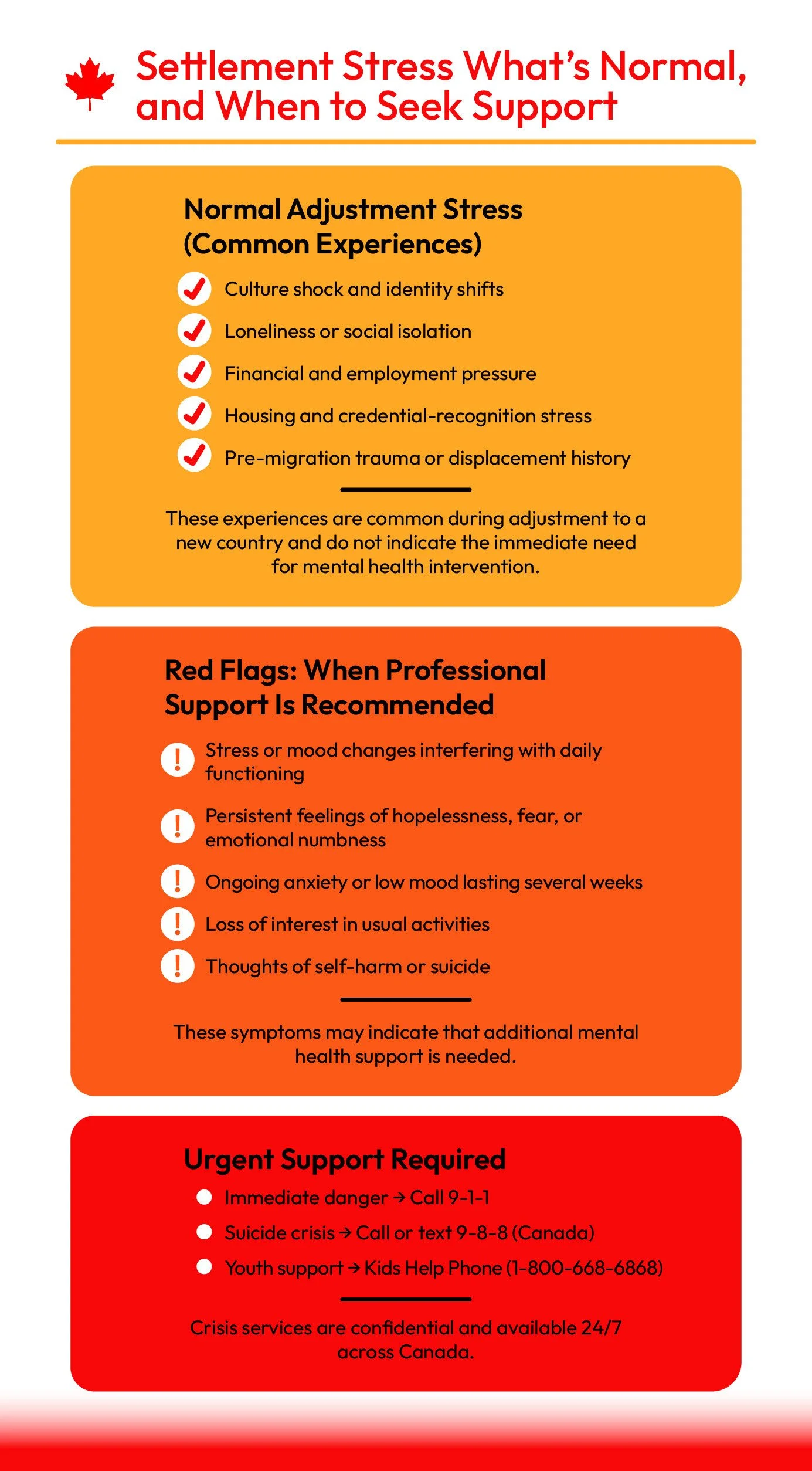
"Settlement stress" refers to the emotional, social, and psychological strain individuals or families experience when moving and adjusting to a new country. According to reports (including one from the Longitudinal Survey of Immigrants to Canada), between 16% and 29% of immigrants report experiencing high levels of stress, including emotional issues.
Common stressors include:
Culture shock and identity shifts that happen when adjusting to new social norms, systems, and expectations.
Loneliness or isolation, especially when social networks are limited.
Financial and employment stress, like difficulties finding housing, navigating job markets, and credential recognition.
Pre-migration trauma, including exposure to conflict, displacement, or loss.
If you find yourself feeling any combination of these (or all of them!), we want you to know that it doesn’t mean something is wrong with you. It simply means that your brain is adapting to change. And it’s completely normal.
However, you should consider seeking professional support when:
Stress or mood changes interfere with daily life.
You feel hopeless, fearful, or stuck for weeks.
You have thoughts of self-harm or suicide. In these situations, immediate help is essential (see crisis section below).
How to Find Low-Cost and Free Counselling Options

One of the great things about immigrating to Canada is that our country offers many avenues of mental health support that are free or low-cost, especially for newcomers who may not yet have extended health coverage.
Settlement-Funded and Community Supports
Immigration, Refugees, and Citizenship Canada (IRCC) funds settlement agencies that connect newcomers to mental health resources and settlement support services. These services often include counselling or referrals to other professionals.
You can filter these services by language of service, service format (whether online or in person), type, and specific group.
Examples include:
WoodGreen Community Services: Offers single-session counselling for newcomers on emotional wellbeing, anxiety, and everyday challenges.
CICS Canada: Provides newcomer mental health services with a trauma-informed, culturally sensitive approach.
Community and Non-Profit Counselling
Many community organizations offer free or sliding-scale mental health services, including:
MOSAIC (BC): Hosts health and counselling programs, including wellness support and group activities, for immigrants and refugees.
Immigrant and Refugee Services in Toronto (Access Alliance): Offers culturally accessible counselling and mental health supports.
211 – Support and Referrals Across Canada
Dialing 2-1-1 connects you to information about health, counselling, crisis services, settlement support programs, and more, in multiple languages and for communities across all provinces and territories.
Crisis Support: What to Do in Urgent Situations
There may be times when you find that immediate mental health support is necessary. Thankfully, Canada has accessible crisis support options across the country.
General Support
9-1-1: Use this if there is a danger to life or safety.
9-8-8, Suicide Crisis Helpline: Call or text 9-8-8 anytime for confidential support in English or French.
Kids Help Phone: Call 1-800-668-6868 or text “CONNECT” to 686868 for support for children, youth, and young adults.
Wellness Together Canada: Text “WELLNESS” to 741741 for adults and 686868 for youth, to receive mental health and substance use support.
Crisis Services Canada: Call 1-833-456-4566 or text 45645.
Specialized Support
Trans Lifeline: 1-877-330-6366
Sexual Assault Crisis Line: 1-866-578-5566
These services are safe, anonymous, and available even if you don’t have a health card or status documentation.
How to Look for Culturally or Language-Matched Services
Finding a counsellor or support worker who understands your background, culture, and language can make accessing proper mental health support in Canada much easier and far more effective.
Here’s how to actually locate those services in Canada.
Step 1: Start with 211 Canada (Phone or Website)
Dial 2-1-1 or visit 211.ca and ask specifically for:
“Mental health counselling in my language”
“Newcomer or immigrant mental health services”
“Culturally specific counselling”
211 operators can search local programs by language, culture, immigration status, and cost, and will give you contact details for organizations near you.
Step 2: Contact a Settlement Agency in Your City
Settlement agencies are one of the best entry points for culturally matched support. Here’s what to ask them when you call:
If they offer in-house counselling
If they have counsellors who speak your language
If they can refer you to culturally specific mental health programs
You can find your nearest agency through IRCC’s settlement services page or 211. Settlement workers often know which local therapists and clinics are newcomer-friendly.
Step 3: Use Language Filters in Therapist Directories
Several therapist directories in Canada allow you to filter by language, culture, or specialization. When searching, look for filters like:
Language spoken
Cultural background
Experience with immigrants, refugees, or trauma
Common directories include:
Psychology Today (Canada)
Therapy Today (Canada)
Canadian Counselling and Psychotherapy Association (CCPA) directory
Search terms to use:
“Trauma-informed therapist + your city”
“Immigrant counsellor + your city”
“Counselling in [your language] + Canada”
Step 4: Ask Directly When You Contact a Clinic
It’s okay (and even encouraged!) to ask upfront. You can say:
“Do you have a counsellor who speaks [your language]?”
“Do you offer culturally sensitive counselling for newcomers?”
“Do you have experience supporting immigrants or refugees?”
Clinics are used to these questions, and asking early saves time and frustration for everyone.
Step 5: Look for Community or Cultural Organizations
Many cultural associations and immigrant community groups partner with mental health providers or run their own counselling programs. Try searching:
“[Your nationality or language] community association + mental health”
“Immigrant women’s centre + counselling”
“Refugee support organization + counselling”
These groups often provide:
Free or low-cost counselling
Interpretation services
Group support in your first language
Why It Matters
The mental health of newcomers to Canada is about more than just language barriers or the usual stress that comes with moving to a new city. It’s also about cultural perspectives on stress, healing, and community. Services that are culturally responsive and sensitive often:
Understand cultural norms around mental health disclosure.
Use trauma-informed care and respectful approaches.
Offer services in languages you feel more comfortable with.
Examples of Cultural Support
The Kids Help Phone offers counselling and support in more than 100 languages, with interpreters available.
Organizations like CIWA offer culturally responsive counselling tailored to immigrant women, seniors, and youth.
Settlement agencies often provide interpretation to connect you with counsellors who speak your language.
What to Expect From Walk-in Counselling vs. Therapy vs. Group Supports

Not all mental health support looks the same. Knowing the differences between walk-in counselling sessions, therapy sessions, or support groups can help you choose which one that best fits your needs, comfort level, and schedule.
Here’s what you can expect from each of them:
Walk-in Counselling
Usually, same-day support for immediate concerns.
Focused on short-term coping strategies.
Often free or low-cost at community clinics or settlement agencies.
Good for: stress relief, emotional check-ins, and short-term problem-solving.
Therapy (Longer-Term)
Provided by registered psychologists, social workers, or counsellors.
Structured sessions over weeks or months.
Can address deeper emotional or trauma-related concerns.
Good for: anxiety, depression, trauma, relationship worries, long-term wellness.
Group Supports & Peer Networks
Support groups bring people together who share similar experiences.
Offers connection, peer learning, and a sense of community.
Good for: adjusting to life changes, reducing isolation, strengthening social support.
Resource List: Mental Health Support Services by Province
No matter where you have landed in Canada, there are free or low-cost resources available to you. Below is a brief list of support initiatives, organized by province, to make them easier for you to access.
Alberta
Immigrant Services Calgary: Settlement support and referrals to mental health and community resources.
Calgary Ethiopian Community Association: Community counselling and social support services.
Portail De L’Immigrant Association: Newcomer settlement and counselling supports (Edmonton area).
British Columbia
MOSAIC: Health and counselling programs for immigrants and refugees across Metro Vancouver.
SUCCESS BC: Multilingual settlement services with mental health and wellness supports.
BC-211: Province-wide referral line for mental health, crisis, and settlement resources.
Manitoba
Immigrant Centre Manitoba: Settlement services and mental health referrals for newcomers.
Mount Carmel Clinic (Winnipeg): Community health clinic offering counselling and newcomer-friendly services.
Manitoba 211: Referral service for counselling, crisis, and community supports.
New Brunswick
Multicultural Association of the Greater Moncton Area (MAGMA): Settlement and wellness supports.
New Brunswick 211: Province-wide referral service for mental health and social services.
Horizon Health Network Mental Health Services: Public mental health services (self-referral available).
Newfoundland and Labrador
Association for New Canadians (ANC): Settlement and wellness supports, including counselling referrals.
Bridge the gApp (NL): Free online mental health navigation and support.
NL 211: Referral service for counselling and social services.
Nova Scotia
Immigrant Services Association of Nova Scotia (ISANS): Settlement services and mental health referrals.
Canadian Mental Health Association – NS: Non-crisis mental health supports.
NS 211: 24/7 referral service in multiple languages.
Ontario
Access Alliance Multicultural Health and Community Services: Mental health counselling with cultural and language supports.
WoodGreen Community Services: Newcomer counselling and settlement assistance.
Stella’s Place (Toronto): Youth mental health centre offering counselling and peer support (free/hub-based).
211 Ontario: Province-wide resource and referral service.
Prince Edward Island
PEI Association for Newcomers to Canada (PEIANC): Settlement services and mental health referrals.
Mental Health PEI – Open Access Counselling: Walk-in and phone-based counselling services.
PEI 211: Referral line for community and mental health supports.
Quebec
Welcome Collective (Montreal): Mental health and social services hub for English-speaking newcomers.
CARI St-Laurent: Multilingual settlement services and psychosocial supports.
Info-Social 811 (Quebec): 24/7 psychosocial support and crisis navigation.
Saskatchewan
Saskatchewan Intercultural Association (SIA): Settlement and wellness referrals (Regina).
Open Door Society (Saskatoon): Newcomer settlement services with mental health navigation.
Sask 211: Province-wide referral line for mental health and community services.
Territories (Yukon, NWT, Nunavut)
Yukon Learn Society: Settlement and wellness navigation.
NWT Help Line: 24/7 mental health and crisis support.
Nunavut Kamatsiaqtut Help Line: 24/7 mental health support (Inuktitut & English).
211 Canada: Referral support for all three territories.
Tip for Readers
Bookmark 211 Canada and Kids Help Phone. They’re updated constantly, available nationwide, and can connect you to culturally matched, low-cost, and urgent mental health support in your community.
How to Talk to a Clinician if You’re Worried About Immigration-Related Stigma

Talking about emotional struggles, especially when tied to migration experiences, trauma, or status uncertainty, can feel pretty intimidating, but it doesn’t have to be. Our experts at Panel Physicians have a few tips that can help:
Prepare what you want to say in advance. Write down challenges you’re facing, even if they feel unrelated to mental health.
Be open about cultural concerns. It’s okay to say, “I want support that respects my culture and background.”
Ask about confidentiality. In Canada, health professionals are bound by privacy laws, which means that they cannot share your personal health information without your consent.
Remember: seeking help is a strength, not a weakness. Clinicians are trained to support newcomers from diverse backgrounds, and asking for culturally matched care is your right.
A Final Word From Our Panel Physician Experts
Settling into a new country is a journey, and mental health is a key part of it. Whether you’re looking for crisis support, peer-led groups, culturally sensitive counselling, or longer-term therapy, Canada has a range of supports across provinces and communities just waiting for you to call or click.
At Panel Physicians, we suggest that you start with local resources, connect with settlement agencies, and absolutely do not hesitate to ask for help when you need it. With the right support, you can build emotional resilience as you build a new life in Canada. And don’t forget to schedule your Immigration Medical Exam with one of our Panel Physicians if you haven’t done so already.