Proof of Funds for Canada’s Express Entry in 2026: How Much You Need and How to Prove It
Summary:
Proof of Funds, or Settlement Funds, is the documented financial proof confirming that FSWP and FTWP Express Entry applicants can support themselves and their families after immigrating to Canada without relying on government assistance. During its eligibility checks, IRCC considers more than just the minimum required. They also ensure that the funds are stable, accessible, and free of debt. For many Express Entry applicants, these settlement funds should be a central part of their immigration planning.
Estimated Reading Time: ~8 minutes
What You’ll Learn:
Who must provide Proof of Funds and who is exempt
2026 settlement fund requirements by family size
How IRCC assesses funds for availability, transferability, and debt
Common documentation issues that cause delays or refusals
Next Steps:
Confirm whether Proof of Funds applies to your Express Entry program
Compare your available funds to current IRCC thresholds
Review bank letters and statements for completeness and accuracy
Prepare your Proof of Funds along with your required Immigration Medical Exam
Proof of Funds (POF), also called Settlement Funds, is IRCC’s way of confirming that you have enough liquid, usable money to support yourself (and your family, where applicable) after you arrive in Canada without needing government assistance. It also confirms that the funds are yours to use.
A strong proof-of-funds document depends on understanding what IRCC evaluates, what documents must be provided, and which financial patterns commonly trigger their scrutiny.
One important thing to note is that financial readiness is only one part of Express Entry preparation. You’ll likely also need to complete an Immigration Medical Exam, which must be performed by a designated Panel Physician. Doing so sooner rather than later can help prevent delays to your application.
Why Proof of Funds Matters for Newcomers to Canada

If you are invited to apply for Express Entry into Canada, you’ll need to provide the Canadian Government with written proof that you have the money to do so.
Who Needs Proof of Funds
Individuals who seek Express Entry need to show proof of funds to meet the minimum requirements of the following programs:
Federal Skilled Trades Program (FSTP)
Who Doesn’t Need Proof of Funds
Typically, you don’t need to show proof of funds if:
You’re applying under the Canadian Experience Class (CEC)
You are already authorized to work in Canada and you have proof of a valid job offer (this applies even if you originally applied under FSWP or FSTP)
One important thing to note is that when you apply, the system may still ask all applicants to upload a proof-of-funds document. If you are exempt, the IRCC says you should upload a letter explaining your exemption (your CEC invitation or a valid job offer plus your authorization to work).
If you’re not sure where you fit in Express Entry, our Panel Physician experts have put together a guide to help explain how Express Entry draws work, so you can orient yourself before you document anything.
2026 Settlement Funds Requirements

IRCC updates proof-of-funds amounts annually based on 50% of the low-income cut-off (LICO) amounts.
LICO is a threshold set by Statistics Canada that identifies income levels at which the average low-income Canadian family spends 20% more than the average on food, shelter, and clothing. This number is used to measure poverty.
As of July 2025, the minimum settlement funds for 2026 are as follows:
| Family Members | Minimum Funds (CAD) |
|---|---|
| 1 | $15,263 |
| 2 | $19,001 |
| 3 | $23,360 |
| 4 | $28,362 |
| 5 | $32,168 |
| 6 | $36,280 |
| 7 | $40,392 |
| Each additional family member | +$4,112 |
Determining Family Size
When counting family size to determine the amount of settlement funds you need, IRCC asks that you include yourself, your spouse or partner, and any dependent children that you and your spouse/partner have alone or with each other, even if they aren’t coming with you, or they’re already Canadian citizens or permanent residents.
A Note From Our Experts
IRCC assesses your funds in Canadian dollars and expects you to remain eligible from the point of application. If your balance drops below the threshold due to exchange rates or normal spending, it may raise questions about your eligibility.
The simplest way to avoid this problem is to maintain a buffer above the minimum, especially if your funds are held in another currency. Make sure to check regularly, as exchange rates vary over time.
IRCC POF Definitions: Available vs. Transferable and Unencumbered

When an IRCC immigration officer reviews your proof of funds statements, they aren’t just looking at the total. They’re looking for three specific qualifications:
Available: Can you withdraw this money today? These funds must be available to you both when you apply and when IRCC issues your permanent resident visa. This means a one-day balance spike is not what IRCC is looking for. They want stable, explainable funds you can actually use.
Transferable: Can this money be moved to Canada? You need to prove that you can legally access the funds upon arrival in Canada. If your funds are in a country with currency controls or restrictions, plan to document that the money can be transferred.
Unencumbered: Is this money free of debt? You cannot borrow a loan or use equity on real property to meet the POF requirements. IRCC requires a bank letter that lists your outstanding debts, such as credit cards and loans, for this exact reason.
Accepted Proof Types (And What Usually Gets Questioned)

IRCC’s baseline expectation is an official bank letter from each financial institution where you hold accounts.
This bank letter must be on the official letterhead of the institution, and include:
Bank contact information
Your name
Your outstanding debts (credit cards, loans, etc.)
For each current banking/investment account:
Account numbers
Dates each account was opened
Current balance
Average balance for the prior six months
What Commonly Triggers Follow-Up Questions
Even with a proper bank letter, IRCC often sees patterns that tend to draw scrutiny:
Large recent deposits with no explanation
Accounts opened recently
Balances that hover right at the minimum (especially with foreign currency)
Funds held in places that aren’t clearly liquid (or aren’t clearly yours)
Common POF Mistakes That Cause Delays or Refusals
IRCC regularly flags applications for additional review when documentation is incomplete, unclear, or inconsistent. So it’s important that you understand the most common mistakes that can lead to the delay or refusal of your application.
Our Panel Physician experts have compiled a list of common errors to avoid in your submission:
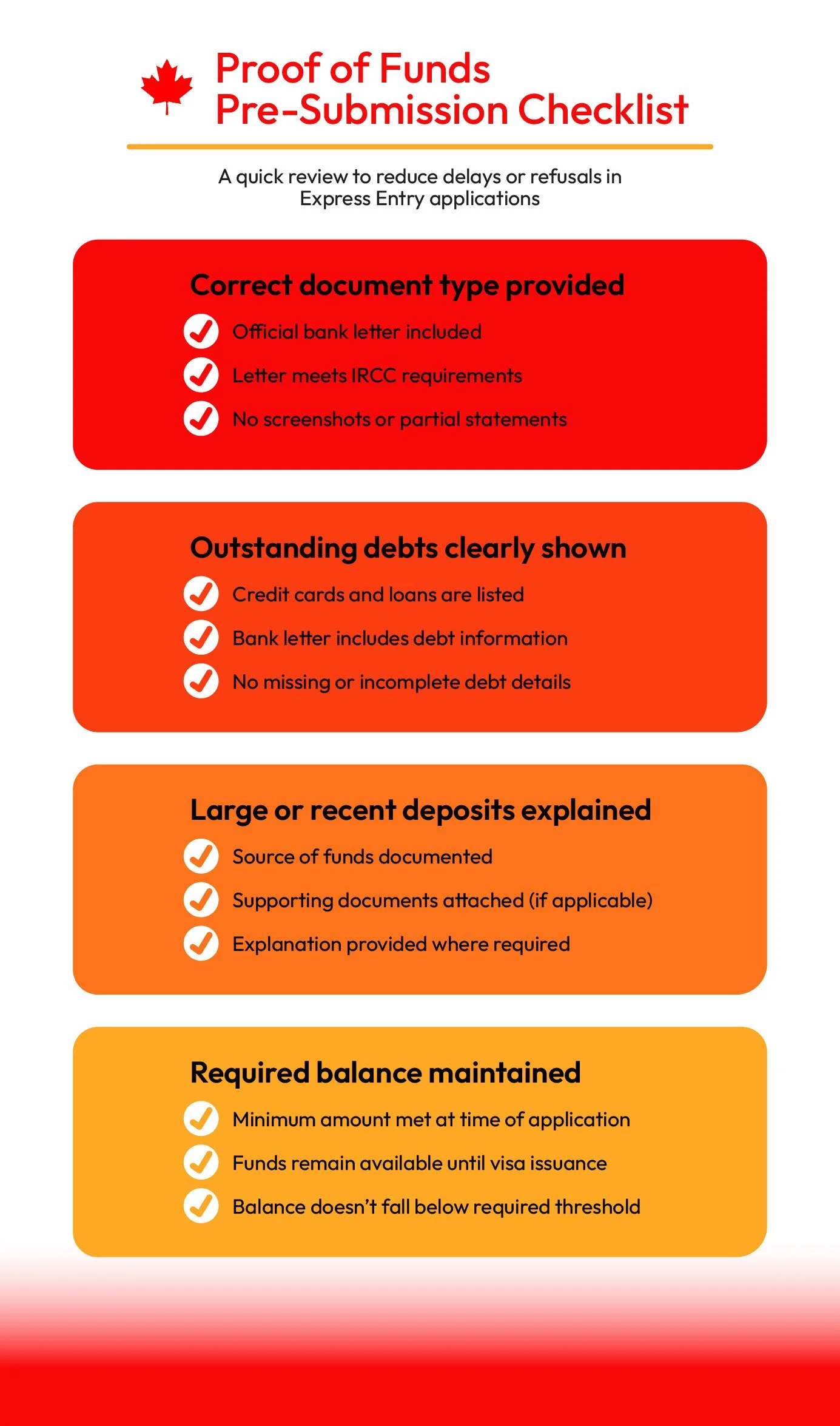
Submitting the wrong document: Screenshots or partial statements are not a substitute for the full bank letter IRCC specifies.
Counting money that doesn’t qualify: No loans, borrowed money, or home equity.
Not accounting for debt visibility: IRCC expects outstanding debts to appear in your bank letter. If your letter is missing this, it may be treated as incomplete.
Not explaining large deposits: A large deposit isn’t automatically disqualifying, but unexplained ones are a common reason files get delayed for review.
Letting balances drop after submission: Your POF should be available from the moment you apply until a visa is issued.
Planning for Currency Fluctuations

If your settlement funds are in a currency other than CAD (for example, INR, NGN, PHP, etc.), IRCC uses the exchange rate on the day they process your application.
What this means is that if the Canadian dollar gets stronger from the date of your application to the date of processing, your savings might actually fall below the minimum.
The solution to these potential fluctuations is to always keep a buffer of at least $1,000–$2,000 CAD on top of the POF you already have to protect against exchange rate swings.
Gifts
Gifted funds can count towards your POF as long as they are clearly identified as a gift, not a loan, and the paper trail is clean.
A clean documentation package includes:
A signed gift letter (and notarization if available)
Evidence of transfer (bank-to-bank trail)
A brief explanation letter connecting the documents
Large Deposits
If there has been a large deposit to your account within the six-month window, and it’s being used to calculate your average balance, be ready to document its source (sale agreement, payroll letter/bonus statement, inheritance documentation), and include a short explanation.
Interactive Proof-of-Funds Tracker: Your Readiness Check
Proof of Funds Readiness Calculator (2026)
Use this quick check to estimate whether your funds appear sufficient and what documentation issues may trigger extra review. (This is an informational tool, not legal advice.)
Step 1: Inputs
Step 2: Results
Documentation flags
| Family size | Minimum required (CAD) |
|---|
These minimums are based on the 2025 LICO amounts published by IRCC. Check canada.ca for the most current figures.
Planning Ahead For Your IME
Proof of Funds and required medical exams often run in parallel during the “invited to apply” stage, and planning ahead for both can reduce the risk of last-minute delays.
As of August 21, 2025, IRCC states that Express Entry applicants must complete a medical exam before applying. Permanent resident medical exams must be completed with a dedicated Panel Physician.
When you’re ready to complete your medical exam, book your Immigration Medical Exam with one of our certified Panel Physicians.