“My Doctor Found Something”: What Happens When an IME Result Gets Flagged?

Summary:
A flagged immigration medical exam result means IRCC needs more information before it can finish its review. Known as furtherance, the request can call for repeat tests, sputum samples, or a specialist report, and panel physicians only refer applicants to specialists when IRCC instructs them to, except for suspected active TB. Testing and specialist availability tend to add the most time. Outcomes range from a completed medical to medical surveillance or a procedural fairness letter, which still isn't a refusal.
Time to Read: ~7 minutes
What You’ll Learn:
How a flagged result differs from a refusal
Where follow-up requests come from and when a specialist referral can happen
How the specialist referral process works step by step
What timing and outcomes to expect after a flag
Next Steps:
Read your IRCC instructions and note the deadline
Book any requested tests or specialist visits right away
Keep copies of every letter, result, and report
Contact our team at Panel Physician about follow-up testing
One Panel Physician patient had just finished their immigration medical exam when the physician mentioned that their chest X-ray showed an area worth a closer look. They'd likely need a follow-up test, and possibly a specialist report, before the file could be finalized.
Their first question was the one most people ask in that moment. Does this mean my application is going to be refused?
In most cases, it doesn't.
A flagged result means IRCC, or the panel physician, needs more information before completing the medical portion, and the application usually stays open while that happens. If you're facing a follow-up request, our team at Panel Physician can walk you through what it involves.
What Does a Flagged Result on an IME Mean?

The word "flag" isn't an official IRCC term, but it's how many applicants describe the moment a result needs a second look. It helps to separate the two roles in the process.
Panel Physicians Record Findings, and IRCC Decides
A panel physician examines you, completes the required tests, and submits your results to IRCC through eMedical. Your panel physician doesn’t decide whether you're admissible to Canada. IRCC medical officers make that decision by reviewing results against three grounds: risk to public health, risk to public safety, and excessive demand on health or social services. Understanding medical inadmissibility and excessive demand explains each one in more detail.
Why IRCC Asks for More Information
When IRCC needs more information before finishing its review, it sends what's called a furtherance request. This means that a finding needs clarifying, a test needs repeating, or a condition needs current documentation from a specialist. Many applicants who receive one go on to have their medical completed without further issues.
How a Flag Differs From a Refusal
| A Flagged Result (Furtherance) |
A Refusal | |
|---|---|---|
| What It Is | A request for more medical information | A final decision on the application |
| Application Status | Still open and in progress | Closed |
| What You’re Asked to Do | Complete specific tests or provide reports by a deadline | Nothing further through the medical process |
| Chance to Respond | Yes, through the requested tests or documents | No |
Where Can a Flag on an IME Come From?
A follow-up request can start at two different points, which is why some applicants hear about it at the clinic, and others hear about it weeks later.
During or Shortly After Your Appointment
If something from the exam needs a closer look, the panel physician may ask for another test or a specialist report before sending the results to IRCC. Getting that information first can help avoid questions or additional requests later in the process.
After IRCC Reviews Your Results
A furtherance request can also come after IRCC has reviewed the medical results. If that happens, you'll receive instructions through your online account or by letter, along with a deadline for completing the requested follow-up.
Related Reading: What Happens After Your Immigration Medical Exam
Here's how a follow-up often looks for a few common findings:
| Finding | What May Be Requested | What Often Happens Next |
|---|---|---|
| Chest X-ray shows scarring or an unclear area | Another X-ray, sputum tests, or specialist review | Many files move forward once active TB is ruled out, and some lead to medical surveillance. See: What to Do If You Have an Abnormal Chest X-ray or TB Screening |
| Blood or urine result outside the expected range | Repeat testing or a specialist assessment | Updated results clarify the finding |
| Known chronic condition with limited records | A specialist report on current status and treatment | Reviewed alongside your original exam. |
| Mental health history noted on the questionnaire | A report from a treating psychiatrist or physician | Reviewed for stability and current care |
How the Specialist Referral Process Works

A specialist referral can sound daunting, but the process tends to follow a fairly predictable order.
Read the instructions closely. Note the exact test or type of specialist, any forms involved, and your deadline.
Book promptly. Specialist availability is often the longest part of the process, so it's worth calling as soon as you have the request.
Bring the right documents. That means the IRCC letter or referral, photo ID, past medical records, and any earlier X-rays or test results.
Attend the appointment. The specialist assesses you and writes a report in the format IRCC requires.
Your results go back to IRCC. The panel physician submits the report through eMedical, the same way your original exam was.
IRCC reviews the update. In most cases, the officer can finish the review. Occasionally, they may ask for one more piece of information.
Two practical questions come up with nearly every referral.
Who Covers the Cost of a Referral?
Additional tests and specialist consultations are the applicant's responsibility and aren't included in the original exam fee. Current Panel Physician clinic fees can be found on our website.
Does a Flag Mean Starting Over?
A furtherance request adds to your existing exam, which means you typically won't need a full new Immigration Medical Exam unless IRCC specifically asks for one. But that’s an entirely different situation, and you can read about it in re-medical requests.
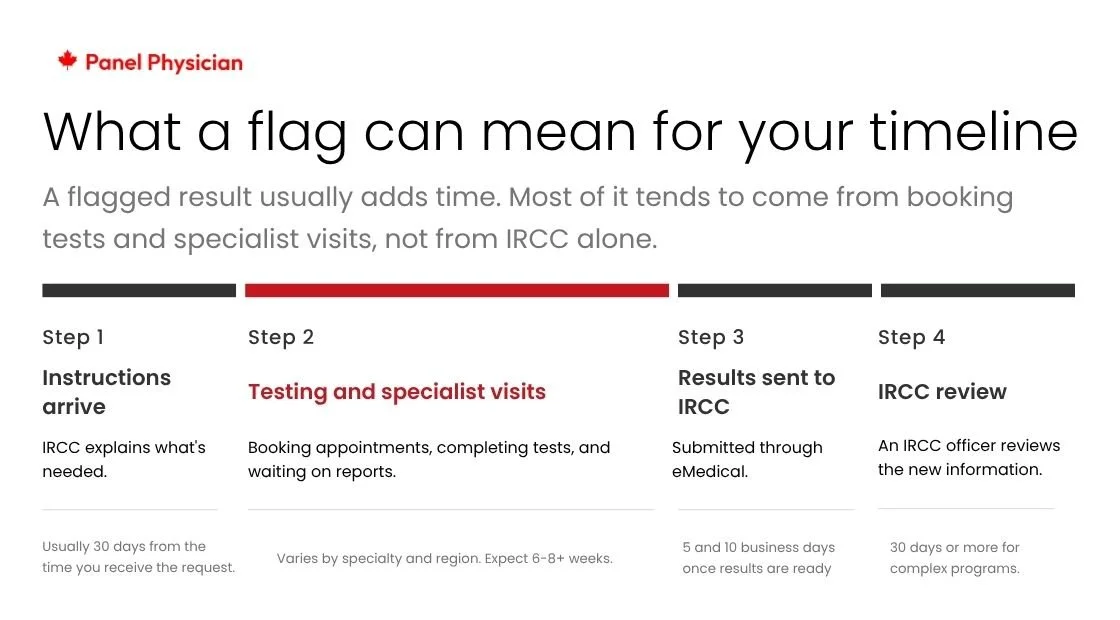
Setting Realistic Timing Expectations
A flag will, of course, add time to the process, with the biggest variables usually being specialist availability and how long certain tests take, not IRCC alone.
Medical results are valid for 12 months from the original exam date, so a long follow-up can sometimes lead to a re-medical request.
The Possible Outcomes After a Flag

Once IRCC has the new information, a flagged result can resolve in a few different ways. Most are more manageable than people expect.
Your Medical Is Completed: The additional information answers IRCC's question, and the medical portion of your application moves forward like any other.
You're Placed Under Medical Surveillance: This is common with findings like inactive tuberculosis. You'll likely be expected to report to provincial or territorial public health for ongoing monitoring. It's a follow-up step, not a refusal.
Treatment Comes First: If the finding is something like active TB, you must complete treatment before IRCC can continue processing the application. Once treatment is finished, the medical process can move ahead.
You Receive a Procedural Fairness Letter: A procedural fairness letter isn't the same as a refusal. It explains what concerns IRCC has identified and gives you 90 days to respond. In most cases, sponsored spouses, partners, dependent children, and refugees are exempt from the excessive demand ground, although the public health and public safety rules still apply. If you receive a letter, it's a good idea to speak with a regulated Canadian immigration consultant (RCIC) or immigration lawyer.
What You Can Do While You Wait
A few small habits can keep a follow-up request from turning into a delay.
Write your deadline down somewhere you'll see it every day
Book specialist appointments as soon as you can
Keep copies of every letter, test result, and report
Keep your email and mailing address current in your IRCC account
Make sure your answers match your original medical history questionnaire
Call the panel physician's office if you're unsure what a request is asking for
A Flag Is Part of the Process
Hearing that something on your Immigration Medical Exam needs a closer look can be nerve-wracking, but a flagged result is really just a request for information, not a final answer. The steps to take are clear, and responding quickly is the best way to protect your application timeline.
Panel Physician is an IRCC-authorized clinic with five GTA locations. Results go directly to IRCC through eMedical, so you don't need to send them separately. Our Panel Physician team has experience with follow-up testing and complex health histories. If you've received a follow-up request or need to book your exam, contact us today. We can help.