
Summary:
Medical inadmissibility is the process IRCC uses to review whether a health condition could affect public health or safety, or put strain on Canada’s health or social services. These assessments focus on long-term care needs, treatment stability, and medical documentation. A medical condition doesn’t automatically disqualify you from immigrating to Canada, especially when your records are clear and well-organized. Understanding the factors medical officers use to determine medical admissibility can help you respond to concerns and prevent delays in the process.
Estimated Reading Time: ~8–9 minutes
What You’ll Learn:
What medical inadmissibility means and how IRCC assesses health conditions
How excessive demand reviews are used to evaluate long-term healthcare and social service needs
What a procedural fairness letter is and how applicants can respond
How strong medical documentation and preparation can reduce delays
Next Steps:
Gather complete medical history, treatment plans, and specialist reports
Review immigration timelines and understand when medical exams are required
Organize documentation early to prepare for possible follow-up requests
Schedule your Immigration Medical Exam with a Panel Physician when ready
Medical screening is a standard part of the vast majority of Canadian immigration processes. For many applicants, this step can be a bit anxiety-inducing because it’s often misunderstood. Medical assessments aren’t designed to exclude people unfairly. Instead, they help Immigration, Refugees and Citizenship Canada (IRCC) determine whether an applicant’s health condition could affect public health, public safety, or place significant pressure on Canada’s publicly funded health and social services.
At Panel Physicians, we believe that clarity is the best cure for anxiety. Understanding how medical admissibility works, especially the concept of “excessive demand,” can help applicants prepare properly, reduce anxiety, and avoid preventable delays during immigration processing.
What Medical Inadmissibility Is (and What It’s Not)

Medical inadmissibility is a decision made by IRCC when a person’s health condition may make them ineligible to enter or remain in Canada. Under the Immigration and Refugee Protection Act (IRPA), the Canadian government ensures that newcomers do not compromise the country’s health systems.
There are three primary reasons an applicant might be found "medically inadmissible":
Danger to Public Health: This usually involves active, infectious diseases that could spread to others, such as untreated tuberculosis or syphilis.
Danger to Public Safety: This covers conditions that might lead to unpredictable or violent behaviour, or sudden physical or mental incapacity (e.g., certain severe, unmanaged psychiatric conditions).
Excessive Demand: This applies if your health needs are expected to cost more than the average Canadian’s healthcare, or if they would increase wait times for others.
Important Note: "Medical inadmissibility" is not a judgment on your worth or your ability to contribute to Canada. It is a financial and capacity-based assessment of the public healthcare system.
What Medical Inadmissibility Is NOT
It is not automatically triggered by having a medical condition
It is not decided by the Panel Physician conducting the medical exam
It is not about your ability to work
It is not a blanket denial
It is not always permanent or final
IRCC assesses each applicant individually, and there is no specific diagnosis that automatically leads to refusal based on excessive demand.
Many applicants with chronic or long-term health conditions are still approved when their documentation clearly shows stable treatment, manageable costs, or realistic care planning.
How "Excessive Demand" Assessments Work

“Excessive demand” is one of the most common reasons medical inadmissibility is discussed. It refers to situations where IRCC believes an applicant’s health needs may place too much strain on publicly funded health or social services.
IRCC evaluates whether:
The cost of treating or supporting a medical condition may exceed government thresholds
The services required could increase wait times for Canadians needing the same services
Excessive demand assessments are based on estimated service costs and projected care needs. The government uses cost thresholds that are updated annually based on national healthcare spending.
For 2026, IRCC lists a cost threshold of $28,878 per year, or a total of $144,390 over five years.
Services Evaluated
Health services include hospital care, specialist treatments, medications, medical devices, and nursing care.
Social services include special education, vocational rehabilitation, and residential care services.
Assessments use five-year periods for most health services and ten-year periods for social services required by dependent children.
The Assessment Process
Panel physician examination identifies health conditions requiring ongoing care.
Medical notification to IRCC flags potential excessive demand concerns.
The medical officer analyzes your medical information and projected costs.
Individualized assessment considers your specific circumstances.
What Information IRCC May Consider in Complex Cases

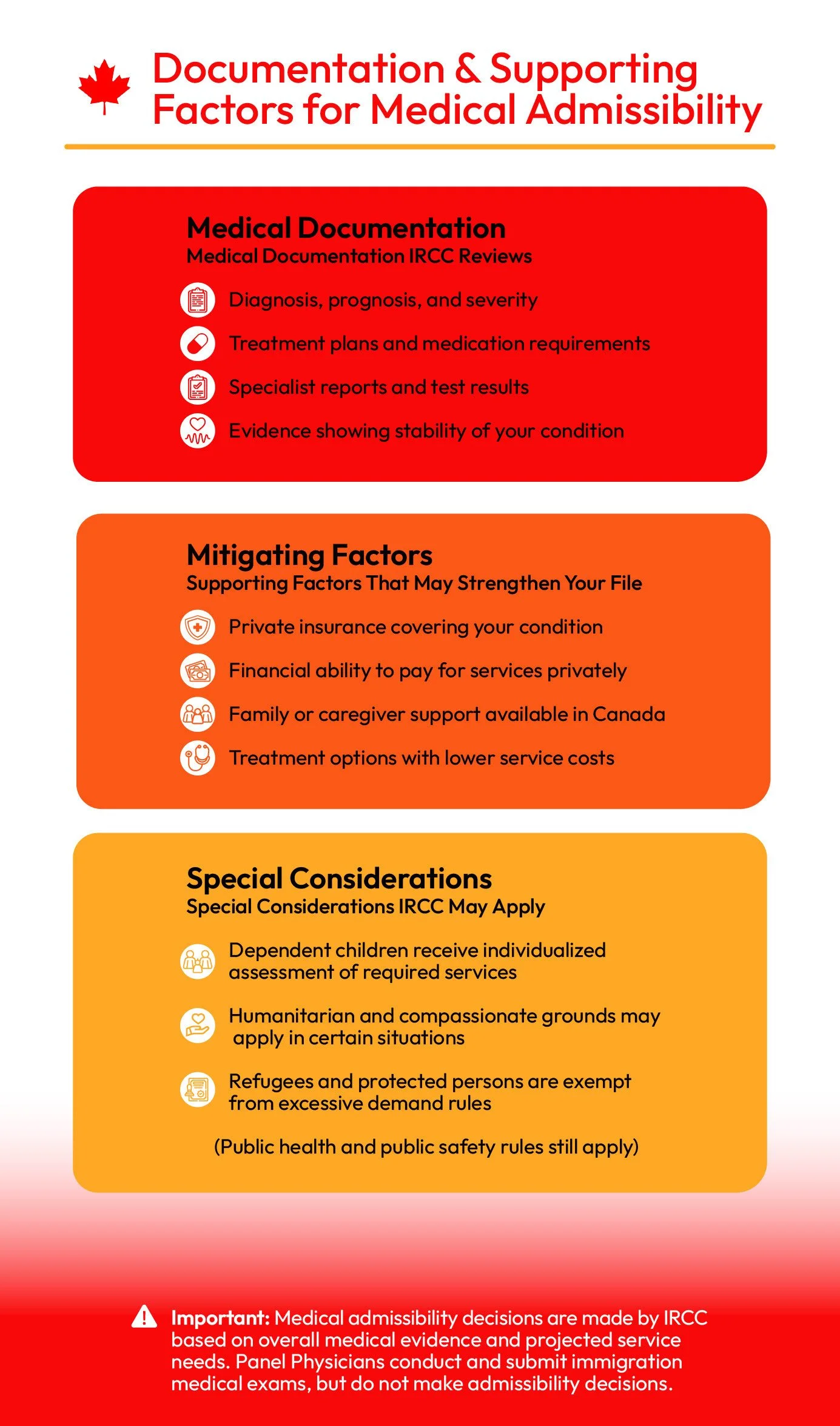
When IRCC reviews medical admissibility, officers do not just look at your diagnosis. They review how a condition may affect your long-term healthcare or support needs.
Information that may be considered includes:
The Specific Diagnosis & Severity: Is the condition stable? Is it in remission?
Anticipated Treatment: What medications or surgeries are likely needed in the next 5 to 10 years?
Wait Times: Would your treatment specifically displace a Canadian on a high-priority waiting list?
The Mitigation Plan: This is your chance to show that you can reduce the burden on the public system (for example, by using private insurance for drugs or proving a lower need for services than the average patient with that condition).
Procedural Fairness Letters
If a medical officer believes you might be inadmissible, they will send you a Procedural Fairness Letter (PFL).
A procedural fairness letter is not a refusal, so do not panic. It's IRCC giving you the opportunity to address any medical concerns before they make a final decision in your case. You generally have 90 days to respond.
What To Do
Read carefully – note every specific concern raised
Don't miss the deadline – late responses may not be considered
Gather comprehensive evidence – updated medical reports, cost projections, insurance documentation
Address each concern directly – respond point-by-point to everything mentioned
Seek professional help – consult Panel Physicians and immigration professionals
Key Elements of a Strong Response
Current medical assessments showing improved or stable condition
Detailed mitigation plans (insurance, financial capacity, family support)
Professional medical opinions from specialists
Cost comparisons showing expenses below the threshold
Well-organized documentation that's easy for medical officers to review
What Parts of the IME Do You Control?
While you cannot control your medical history, you can control how that history is presented. And preparation is your greatest tool.
Accuracy
Bring all past medical records, specialist letters, and current prescriptions to your appointment at Panel Physicians.
Clarity
Be ready to explain your condition clearly. If you have a letter from your doctor stating that your condition does not require hospitalization and is managed by low-cost generic medication, bring it.
Honesty
Misrepresentation (hiding a condition) is a serious offense that can lead to a 5-year ban from Canada. It is always better to be transparent and provide a strong explanation than to leave a gap in your history.
Planning Your Medical Timeline
Medical requirements often move forward at the same time as other immigration steps. Planning ahead helps reduce rushed documentation, unexpected testing delays, or missed application deadlines.
Here are a few things you should know when preparing your medical timeline:
Important Timing Facts
Medical exams are valid for 12 months from the examination date
Standard processing without complications takes a few weeks
Medical inadmissibility cases with PFL procedures can add several months to your timeline
Medical officers prefer information that is less than 3-6 months old
Proactive Steps
Before your IME, you should:
Research private insurance options in Canada
Obtain current specialist evaluations
Calculate Canadian costs for your medications and treatments
Consult with a Panel Physician if you have health concerns or questions
IRCC reviews medical admissibility using IME results and supporting medical documentation. Each case is assessed individually, and having a medical condition doesn’t automatically disqualify you for immigration into Canada. Clear, organized medical information helps IRCC understand an applicant’s health status and care needs more accurately.
Medical Preparedness Checklist for Canadian Immigration
Use this checklist to help prepare for your Immigration Medical Exam (IME). Check off items as you complete them.
Documents to Gather (Ideally 2–3 Months Before IME)
Appointments to Schedule
Information to Research
Deadlines to Track
Medical Admissibility Is About Preparation, Not Fear
Medical inadmissibility and excessive demand assessments are complex aspects of Canadian immigration, but they don't have to be stressful. Understanding how these assessments work, what information IRCC considers, and what you can control in the process empowers you to navigate this part of your immigration journey with confidence.
As IRCC-designated panel physicians, we've helped countless immigrants navigate medical assessments successfully. Whether you need to book a standard Immigration Medical Examination or have concerns about potential medical inadmissibility, our team can provide expert guidance and support throughout the process.