
Summary:
Extending your study permit is one of the most important deadlines for you to remember as an international student in Canada. It protects your legal immigration status and makes sure your studies can continue without interruption. A clear timeline can ensure that you don’t face delays (or outright refusals) when the time comes. Knowing what to prepare now, what to prepare next, and when to submit everything helps reduce your stress and avoid preventable mistakes.
Estimated Reading Time: ~7 minutes
What You’ll Learn:
When to apply for a study permit extension and why timing matters
Which documents students most often miss
How financial proof and school documents are assessed
When an Immigration Medical Exam may be required (and how to book one)
Next Steps:
Check your study permit expiry date and count back 12–16 weeks
Request the required school documents early
Review your financial proof to ensure it meets current requirements
Book an IME with a Panel Physician if your situation requires one
As an international student in Canada, missing your study permit extension deadline can jeopardize your status in this country.
Many students spend their time focusing on classes, housing, and work opportunities, but then find themselves scrambling at the last minute to get everything they need together before their study permit’s expiration date.
Your study permit helps you maintain your legal status in Canada and protects your future immigration options. Missing its extension deadline can cause you a host of problems, including interruption of your studies, affecting work eligibility, and creating immigration complications that can be difficult to fix later.
At Panel Physicians, we aren’t strangers to witnessing the stress that comes with impending expiration dates, which is why we’ve created this guide and free interactive timeline planner. So you can extend your permit without losing focus on your studies.
When You Should Apply for a Study Permit Extension

One of the biggest mistakes international students can make is not applying for their study permit extension at the right time. Apply too late, and you risk losing everything you've worked for in Canada. Apply too early, and you might face outright refusal.
Understanding the golden window for your application is the foundation of a successful extension.
The Risks of Applying Too Late
If your study permit expires before you submit your extension application, you’ll lose what's called "implied status". This is the legal authorization to continue studying while Immigration, Refugees, and Citizenship Canada processes your application.
Here's what can happen if you miss your deadline:
You cannot legally study or attend classes, even if you're enrolled and paying tuition.
You cannot work on or off campus, which means losing your income and potentially your job.
You must apply for restoration of status within 90 days, which is more complex, more expensive ($350 extra fee), and has no guarantee of approval.
If you don't restore your status within 90 days, you may be required to leave Canada entirely and reapply from your home country.
These aren't theoretical consequences! We see them happen to students every semester.
The Downsides of Applying Too Early
You might be thinking, “Okay, well, I’ll just apply early then.” And that may seem like the safe choice, but IRCC also has rules about how far in advance you can submit your extension application:
Applications submitted more than 6 months before your current permit expires may be refused outright.
You'll waste the application fee ($150) and have to resubmit everything later.
Document validity dates might not align properly. For example, financial statements or medical exams may become outdated by the time IRCC processes your application.
Your new permit's validity period might be calculated from the application date rather than your current permit's expiry, potentially shortening your authorized stay.
While the IRCC suggests applying for an extension at least 30 days before your permit expires, some Canadian DLIs (Designated Learning Institutions) suggest applying three to four months in advance.
Build Your Personalized Study Permit Extension Timeline
Now that you understand why timing matters, it's time to create a timeline that's tailored specifically to your situation. No two students have identical circumstances. Your program dates, travel plans, institutional requirements, and personal circumstances all influence when to begin preparing and which steps to take.
Our free interactive timeline planner takes the guesswork out of the process. Simply enter your key dates and information below, and you'll receive a customized, step-by-step roadmap that tells you exactly what to do and when. The planner accounts for document-gathering lead times, potential medical examination requirements, school administrative schedules, and IRCC processing realities to provide a timeline that works.
Study Permit Extension Timeline Planner
Enter your information below to generate your personalized study permit extension timeline. All fields are required for accurate results.
Your Current Study Permit Information
Your Next Study Period
Work and Travel Considerations
Additional Circumstances
Your Personalized Timeline
Phase 1: Initial Preparation (12–16 weeks before expiry)
Phase 2: Document Gathering (8–12 weeks before expiry)
Phase 3: Application Preparation (6–8 weeks before expiry)
Phase 4: Final Review & Submission (4–6 weeks before expiry)
Phase 5: Post-Submission Monitoring (After submission until decision)
- Weekly: Check your IRCC account 2–3 times per week for updates or document requests.
- Enable email notifications and check your spam folder.
- Respond to IRCC requests promptly (deadlines are strict).
The Documents IRCC Expects (That Students Often Forget)

Even the most well-prepared students can overlook important documents when applying for a study permit extension, and missing even one can delay your application by weeks or even result in outright refusal.
Understanding what you need can mean the difference between a smooth approval and a stressful scramble to fix mistakes.
Here are the documents that trip up students the most:
Proof of Enrolment or Acceptance
IRCC officers will usually want a letter from your school on official letterhead that confirms your name, program, and start and end dates. For extensions, the information provided should reflect your current situation (not your original acceptance).
Common mistakes: uploading an informal email, using an outdated letter, or submitting a conditional acceptance instead of an unconditional LOA (Letter of Acceptance) provided to you by the school.
Proof of Financial Support
You must demonstrate that you can cover living costs and tuition, and IRCC often requires funds that remain stable over time (not just a one-time balance). Some common options IRCC accepts include bank statements with at least four months of history, scholarship letters, a GIC, or sponsor support (with proof).
Common mistakes: providing only one month of statements, relying on a recent large deposit with no context, or failing to show currency calculation conversions from one currency over to CAD.
Valid Passport (Passport Expiry Check)
IRCC will not issue a study permit beyond your passport’s expiry date. If your passport expires during your expected study period, you may receive a shorter permit and need to extend it again after renewal.
Common mistake: applying for a long extension while the passport expires soon.
Provincial or Territorial Attestation Letter (PAL/TAL)
Most study permit applicants must submit a Provincial Attestation Letter (PAL) or Territorial Attestation Letter (TAL) with their application. The PAL or TAL confirms that you’ve been allocated a study permit spot within your province or territory under Canada’s study permit cap system.
Common mistake: submitting an application without including a valid PAL/TAL, assuming the school sends it automatically, or reusing one from a previous cap year.
Program Completion Timeline (When Your End Date Has Shifted)
If you need extra time beyond your original program end date (which happens more often than one would think), include documents that show when you will finish and why additional time is needed. This may be an updated transcript, an academic plan, or a letter from your department/advisor explaining the revised timeline.
Common mistake: failing to explain why you’re program end date has shifted, which can make it appear that studies are inconsistent or incomplete.
Explanation Letter (Only When Needed)
Not every extension requires an explanation letter, but it’s helpful when there are study gaps, program changes, institution transfers, delayed completion, or a history of restoration. Keep it clear and factual, support it with documents where possible, and aim for 1–2 pages.
Common mistake: either not including an explanation when one is clearly needed, or writing an overly long, emotional letter without supporting documents.
Co-op or Internship Documentation (If You’re Adding Work-Integrated Learning)
If your program includes a mandatory co-op or internship, be sure to include documentation from your school confirming that the work component is required for program completion (e.g., a co-op agreement or a letter from the institution). In some fields, certain work placements can also affect whether an Immigration Medical Exam (IME) is needed, so plan ahead if your program involves healthcare, childcare, or education.
Common miss: assuming the co-op component is automatically covered by your study permit without submitting documentation showing it’s mandatory.
Custodianship Declaration (For Minors)
If you’re under the age of majority in your province, IRCC may require custodianship documents, which could include notarized declarations from your custodian in Canada and from your parents/guardians consenting to the arrangement.
Common miss: forgetting to update custodianship documents when renewing a permit before reaching the age of majority.
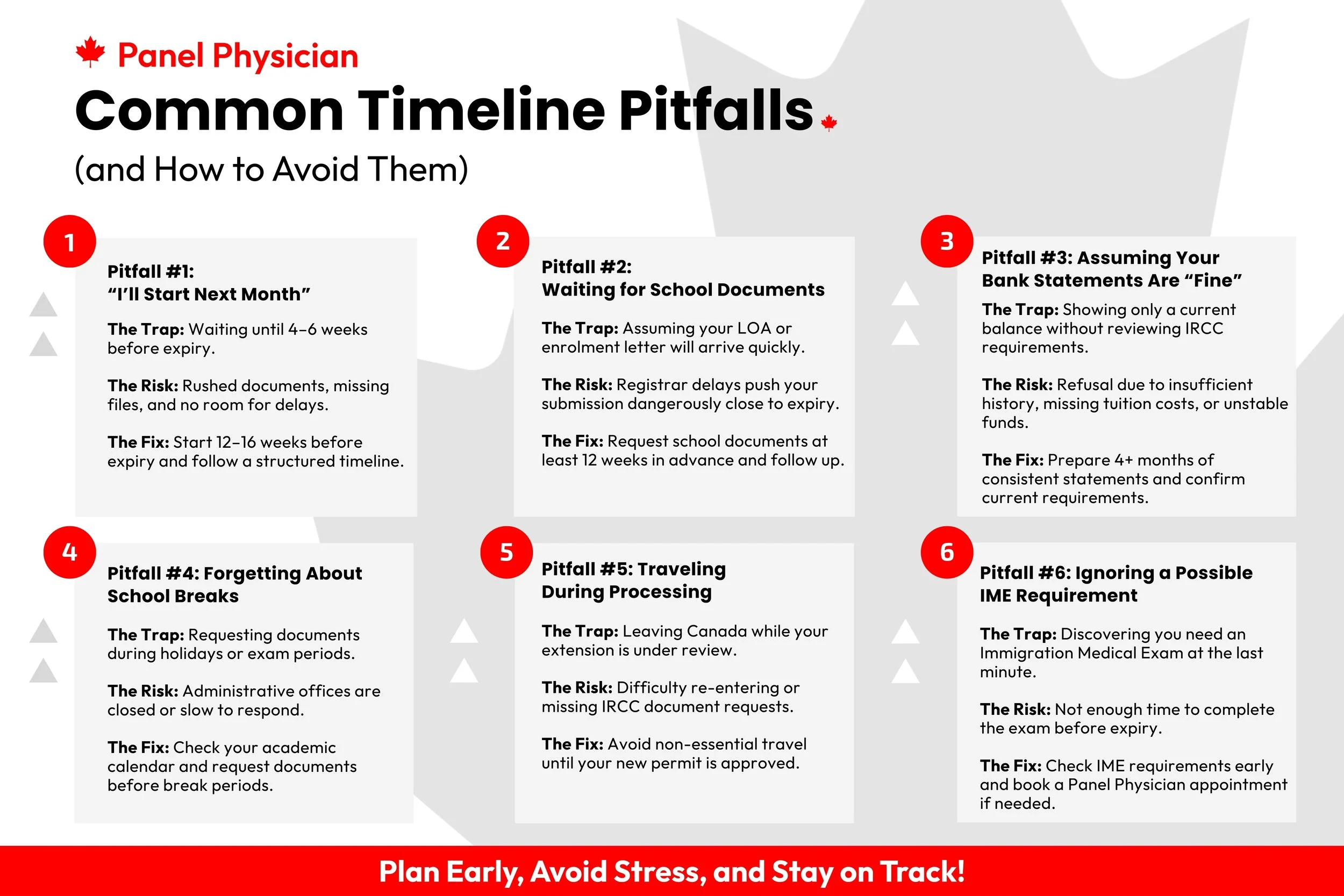
When an Immigration Medical Exam (IME) May Be Required
Not all study permit extensions require a new medical exam, but in certain situations, an updated IME may be necessary.
You may be required to submit to a new IME if you:
Are entering or continuing studies in healthcare-related programs
Are participating in childcare or education placements
Are moving into a certain co-op or work placements
Have lived in certain countries for extended periods
Are transitioning from student status to certain types of work permits
Immigration medical exams must be completed with a government-authorized Panel Physician. Panel Physicians conduct the exam and submit results directly to IRCC. They do not make immigration decisions.
If you anticipate needing a medical exam, building time for it into your extension timeline can prevent delays later. It’s important to note that the IRCC requires your IME exam be performed by an approved Panel Physician. Book your appointment with one of our IRCC-approved Panel Physican today.